Why k34a exists
Software gets complicated.
Systems grow. Workflows become manual. Legacy platforms become harder to change.
And suddenly engineering starts slowing the business down.
That's where we come in.
k34a takes on serious software problems — new products, legacy systems, operational workflows, and the infrastructure underneath them.
When software becomes harder to change than it should be.
Legacy systems
Growing infrastructure
Manual workflows
Unreliable services
Security gaps
AI opportunities
Complex integrations
Scaling problems
Problems we recognize
Some problems don't need another developer. They need someone to own the problem.
Your legacy system works.
You just can't change it.
Your team is doing manually
what software should be doing.
Your product works in development.
Production is another story.
Your workflows became
scripts, approvals, and spreadsheets.
You want to use AI.
You don't want another demo.
Your engineers spend more time
maintaining systems than improving them.
What we do
From the first build to the hardest system in the room.
We don't sell developers. We take responsibility for engineering problems that matter to the business.
01
Product Engineering
Build something new
Turn an idea, workflow, or business requirement into software people can actually use.
POST /api/orders
validate(input)
persist(transaction)
notify(user)
02
Modernization
Fix what already exists
Modernize aging systems, untangle architecture, improve reliability, and make software easier to change.
java:8 → java:25
spring-boot:2.1 → 4.1
rollout(env, safe=true)
healthcheck.pass()
03
Automation
Automate the work
Replace repetitive manual processes with reliable workflows and internal systems.
trigger: request.created
node: validate
node: approve
node: execute
04
AI Engineering
Put AI to work
Build AI into products, workflows, and engineering systems where it creates measurable value.
context.retrieve()
model.generate()
engineer.review()
ship.with.tests()
05
Security & Reliability
Make critical systems dependable
Security, observability, performance, resilience, and infrastructure — when software is already carrying real traffic.
auth.verify()
access.jit()
audit.log()
alert.on.anomaly()
How we work
AI changed how software gets built. It didn't change what good software looks like.
We use AI aggressively during development. Engineers still own the architecture, decisions, security, correctness, testing, and production behavior.
AI-assisted
Engineer-reviewed
Production-ready
How we think
Optimize for the system, not the ticket.
We don't measure success by how many tasks get closed. We care whether the system works, whether the problem is actually solved, and whether the software can keep evolving after we leave.
Our work
Hard problems. Real systems. Measurable outcomes.
Examples of engineering outcomes from engagements with some of the world's largest companies.
Platform modernization
An 18-year-old platform. Four months. Zero downtime.
An aging core system had become increasingly difficult to evolve. Java and Spring Boot modernization with environment-by-environment rollout and production-safe migration.
The platform was upgraded without taking production offline.
18 yrs
legacy platform
9
microservices
25
environments
0
downtime
Reliability engineering
97% less downtime without treating symptoms.
Incidents were steady for weeks. Deployments kept causing instability, and monitoring only surfaced problems after users felt them. Moved discovery to Kubernetes internal DNS, removed the Eureka microservice, added health endpoints and alerting, and fixed root causes instead of recurring symptoms.
Incident rate dropped sharply. Deployment-related downtime became negligible.
97%
less downtime
Security engineering
Time-bound access for sensitive systems.
Permanent access created unnecessary risk in a highly secure environment. Just-In-Time access with approval workflows, time-bound permissions, and full auditability.
Tighter control without making legitimate access unnecessarily difficult.
Time-bound
access
Full
audit trail
Workflow automation
Hardcoded requests became a configurable platform.
New workflows meant engineering changes and deployments. A configurable workflow engine with node-level execution, approvals, auditing, and visibility.
New workflows could be created without changing application code.
No deploy
for new workflows
Node-level
visibility
Pro-bono initiative
Giving Back
Every year, we partner with one nonprofit as their pro-bono technology partner, building and supporting the tools they need at no cost. It is our way of giving back through the technology we know best.
2026 partner: Action Relief Foundation
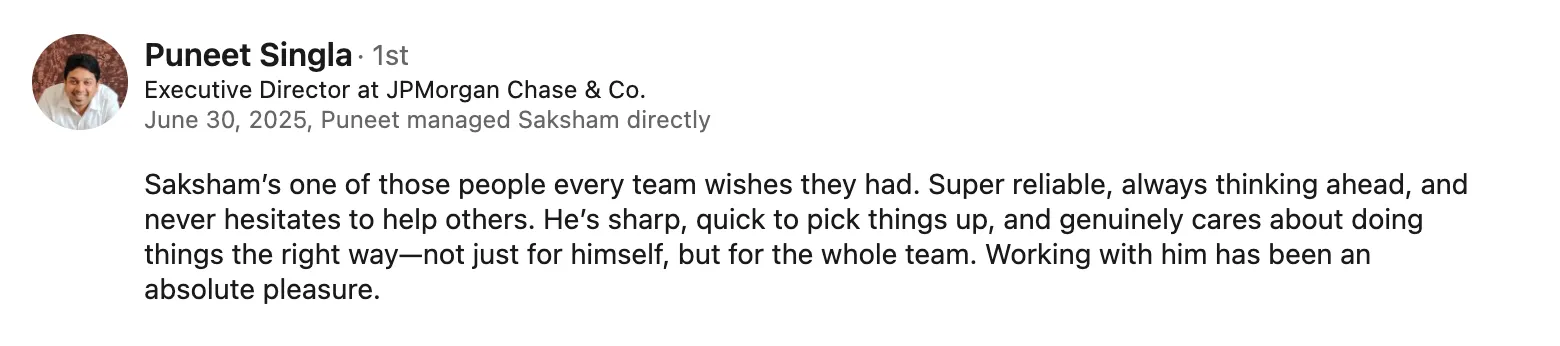
Testimonials
What clients and partners say.
Feedback from people we have worked with — in their own words.

After launch
Shipping isn't the end.
Production is where software meets reality. We stay involved when the traffic arrives, the edge cases appear, and the next problem becomes obvious.
Build, launch, monitor, improve — then keep going. Delivery is not where our responsibility stops.
Principles
We work like engineers, not account managers.
Clear opinions. Direct communication. Ownership that doesn't disappear after deployment.
Don't hide the hard part.
If something is difficult, expensive, risky, or unnecessary, we'll say so.
Own the outcome.
Shipping code isn't the same as solving the problem.
Build for the next engineer.
Readable code, understandable systems, boring reliability.
Use AI for leverage.
Let machines handle the volume. Let engineers make the decisions.
Stay after launch.
The real system starts when users arrive.
About
Built by engineers who got tired of watching good software get buried under process.
k34a was started by engineers who have spent years building and operating production systems across fintech, enterprise software, healthcare, e-commerce, research, and internal platforms.
No layers of account managers between you and the people doing the work.
Small teams. Direct communication. Technical ownership.
Bring us the hard problem.
Tell us what you're building, what's breaking, or what has become harder than it should be. We'll tell you how we'd approach it.